
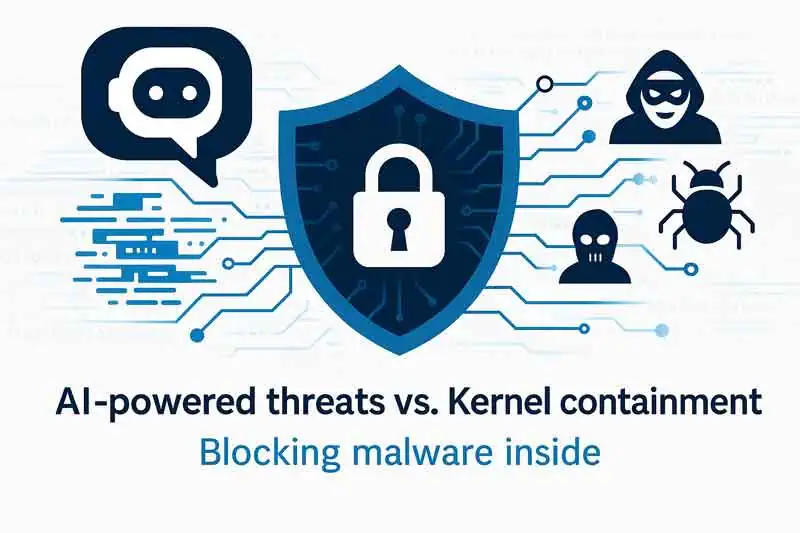
ChatGPT-Like Tools Amplify Malware Risks: Protect with AppGuard Solo
As large language models (LLMs) like ChatGPT advance, they empower cybercriminals to create more sophisticated, harder-to-detect malware, escalating risks for PC users, especially those handling online banking, trading, or cryptocurrency. By leveraging the MITRE ATT&CK framework, this post explores how LLMs worsen cyber threats and why AppGuard Solo’s zero-trust protection is essential for your security.
LLMs: A New Weapon for Cybercriminals
LLMs excel at generating human-like text, enabling attackers to craft highly convincing phishing emails, fake websites, and weaponized documents tailored to victims—using stolen data like your pet’s name or recent bills. In 2024, phishing attacks targeting banking credentials surged 47% (Source: APWG). LLMs also rewrite malware code to evade antivirus (AV), endpoint detection and response (EDR), and extended detection and response (XDR), creating detection gaps that prolong intrusions, with global dwell times averaging three weeks.
Key MITRE ATT&CK Impacts
- Initial Access: LLMs create personalized phishing lures, increasing click-through rates and attack volumes.
- Execution: Rewritten malware code bypasses signature-based and behavioral detection, making malicious files harder to spot.
- Defense Evasion: LLMs spread malicious actions across multiple processes or insert pauses, confounding behavioral detection tools.
- Credential Access: More successful intrusions lead to increased credential theft, with LLMs crafting convincing forged credentials.
- Discovery & Lateral Movement: LLMs analyze compromised systems to target high-value accounts, mimicking normal behavior to evade detection.
- Collection & Exfiltration: LLMs pinpoint valuable data for selective theft, reducing network traffic and detection risks.
These advancements lower the skill barrier for attackers, enabling less experienced criminals to deploy sophisticated attacks, driving up attack volumes and financial losses.
Why Detection-Based Tools Fall Short
Traditional AV, EDR, and XDR rely on recognizing known patterns, but LLMs create polymorphic malware and complex evasion techniques, overwhelming security teams with false positives and increasing alert fatigue. Financial sector breaches rose 22% in 2024 (Source: Verizon DBIR), highlighting the need for a new approach.
AppGuard Solo: Zero-Trust Defense
AppGuard Solo’s controls-based protection doesn’t rely on detection—it enforces strict boundaries to block malicious actions like unauthorized file writes or process launches. Its default policies stop LLM-enhanced attacks without updates, offering:
- Real-Time Protection: Halts malware, ransomware, and zero-day exploits instantly.
- Lightweight Design: Uses under 10 MB, ensuring no slowdown for banking or trading.
- No Updates Needed: Auto-adapts to new threats, unlike AV’s constant updates.
- Easy Setup: Installs in 15 minutes, perfect for non-technical users.
- Compatibility: Enhances antivirus like Microsoft Defender for layered security.
A 2024 case study showed AppGuard Solo stopping a ransomware attack on a trading firm, saving $500,000 in assets. By reducing the attack surface, it cuts SOC costs and alert fatigue, with one airline saving $750,000 annually.
Secure Your Transactions Now
LLM-enhanced malware makes traditional defenses obsolete, putting your financial data at risk. AppGuard Solo’s zero-trust approach stops attacks before they succeed. As an authorized distributor, PCQuick Digital Services offers AppGuard Solo for $89.95/year (up to 3 PCs) with a 30-day free trial. Visit https://appguardsolo.com to start your trial and protect your online transactions today.
To read the source article of this curated post visit www.appguard.us/
About PCQuick Digital Services
AppGuard Solo is a trademark of AppGuard Inc. PCQuick Digital Services, an authorized global distributor, operates https://appguardsolo.com to deliver cutting-edge cybersecurity solutions. Subscribe to our blog for the latest updates!